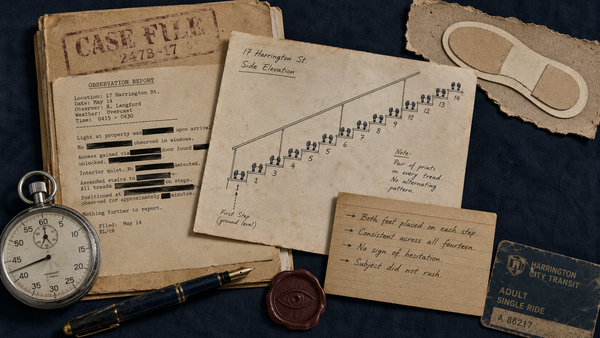
His voice was fine. The sentences were the wrong length.

A pharmacy queue is the only place in this city where a dozen strangers agree to stand still, face the same direction, and stare at the same rack of reading glasses for twenty minutes.
It is the best observation post in New York. Nobody is exerting themselves. Nobody is performing. Everyone is just idling, which is when bodies tell the truth.
Thursday, 11:40 AM. Lexington Avenue, in the Sixties. One counter open. Twelve people deep when I joined.
Third ahead of me: male, late sixties at a guess. Tan windbreaker, zipped halfway. Canvas cap. A paper ticket folded once in his right hand, worn soft at the crease, which means he had been holding it a while.
No cane. No tank. No aid of any kind.
For the first two minutes he did nothing at all, which is normal, because that is what a queue is for.
Then I saw his mouth change shape.
Lips drawn in and narrowed, almost like the start of a whistle. A long, quiet out-breath through the gap. Then his face went back to neutral.
A minute later, again. Then again.
He was standing completely still. He had not climbed anything. He had not carried anything.
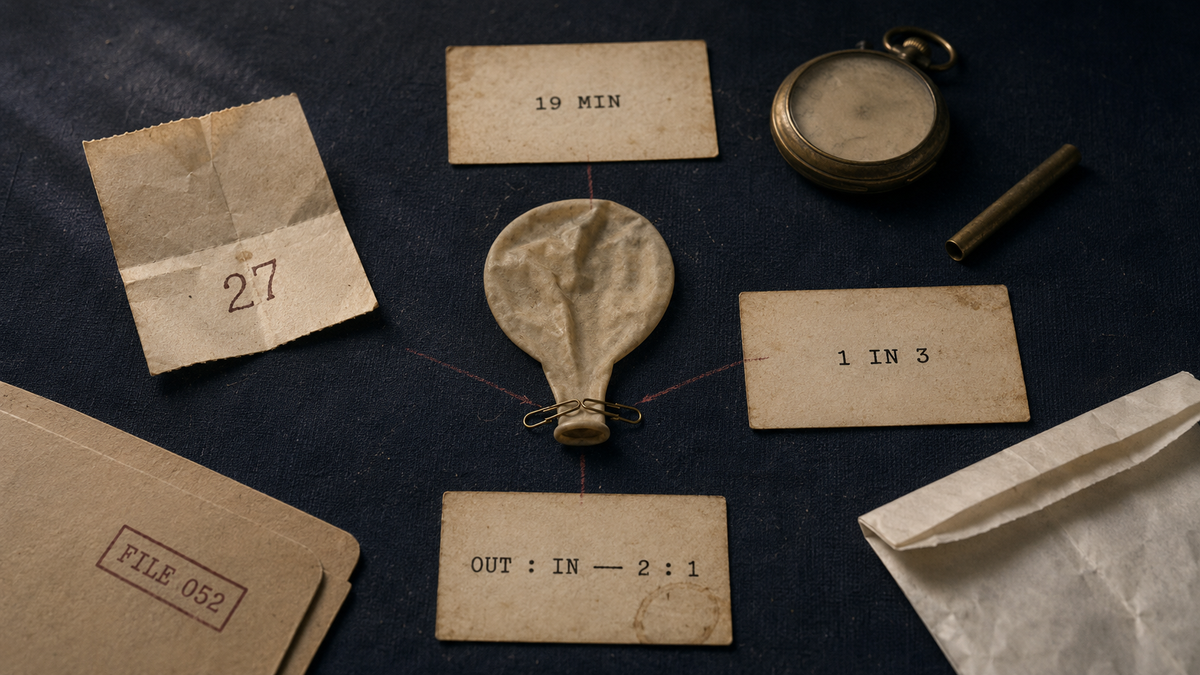
And roughly one breath in three was leaving through a hole the size of a dime.
The Pursed Lip
Observation only · No contact · No identification · File remains open
Three things were happening, and they were happening together.
The shape of the mouth. Lips drawn forward and narrowed to a small opening. Not blowing. Not sighing. Letting air out slowly, under control, through a deliberately small hole.
The ratio. I counted, because counting is most of the job. His in-breath ran about two seconds. The out-breath ran about four. That is backwards from an ordinary resting breath, where the two are much closer together.
The timing. Not every breath. Roughly one in three, in short runs. A few of them, then a gap of a minute or so, then a few more. Never once did he seem to notice.
Then the queue moved and he reached the counter.
Both forearms went onto the ledge before he said anything. Not a lean of impatience — a settle. Shoulders came slightly forward and stayed there.
And he spoke in short pieces. Four words, small breath, four words. His voice was strong. There was no rasp, no cough, no wheeze I could hear over the air conditioning.
The voice was fine. The sentences were the wrong length.
That is the whole file. A man standing perfectly still was doing quiet work to move air, and had built the workaround so long ago that it had stopped being a decision.
"Nobody in that queue was moving. He was the only one still working."
Frame 1 — Minute three. Lips draw forward and narrow on the out-breath. Shoulders stay down. No cough, no audible wheeze, no hand to the chest.
Frame 2 — The out-breath runs roughly twice as long as the in-breath. He is not blowing hard. He is letting air out slowly through a small opening.
Frame 3 — About one breath in three, in short runs, then a gap, then more. Never once does he look down at himself or pause. He does not know he is doing it.
Frame 4 — At the counter, both forearms onto the ledge before he speaks. Then four words, breath, four words. His voice was fine. The sentences were the wrong length.
Log 11:40 AM · Queue 19 min · Observation distance approx. 3 m
Breathing out is supposed to be free.
In healthy lungs the chest and the airways stretch on the way in, then spring back on the way out. You do not push. The recoil does it, the way a stretched balloon empties itself.
When the small tubes inside the lungs are narrowed or floppy, that stops working. Pushing harder makes it worse, because the pressure squeezes the tubes shut before the air has left. So air stays behind.
The next breath then starts from a chest that is already part full. Try taking a deep breath in right now without letting the last one out. That feeling is the whole problem.
Narrowing the lips changes the physics. It raises pressure inside the airways from the inside, which holds the small tubes open a little longer and lets more air escape before they close.
Leaning the forearms on something does a similar job at the other end. Bracing the arms fixes the shoulders, which lets the chest muscles help lift the ribs. Nobody in that queue was taught either of these things. People find them.
Now the part I find hard to sit with.
In 2015 researchers pooled breathing tests from 30,874 adults aged 40 and over, across 44 sites in 27 countries. Just under one in ten had persistent airflow limitation on testing. Of those, 81 percent had never been given the diagnosis.
The lowest underdiagnosis rate anywhere in that entire global survey was 50 percent, in Lexington. Kentucky, unfortunately. I did check twice, standing on the other one.
American numbers look similar. In a national survey, about 12 percent of adults tested showed obstructed airflow, and roughly 72 percent of them reported no prior diagnosis. Meanwhile, about 6 percent of US adults have actually been told they have the condition.
The gap between those numbers is the whole reason I stand in pharmacy queues.
Five points · No jargon · Read it once
- Breathing out should cost nothing. The chest stretches on the way in and springs back on the way out. You do not push. A balloon does the same thing when you let go of the neck.
- Damaged tubes collapse when you push. If the small airways are narrowed or floppy, forcing air out squeezes them shut. The harder you push, the less gets out.
- So air gets left behind. The next breath starts from a chest that is already part full. That is why it feels like you cannot get a breath in, when the real trouble is getting the old one out.
- Narrow lips act as a back-pressure valve. Blowing through a small opening raises the pressure inside the airways and holds the tubes open longer, so more air escapes per breath.
- Nobody is taught this. People arrive at it on their own, often years before anyone has said a word to them about their lungs. That is exactly what makes it worth watching for.
Now I take my own file apart.
Pursed lips are normal. Healthy people do it constantly. Cold air does it. A hill does it. Carrying two full bags up from the street does it, and I have done it myself in the last month, at some volume. On its own, in isolation, it means nothing at all.
What made this one worth a note was the setting. He had been standing still for eleven minutes when it started. There was no work being done that the breath had to keep up with.
The technique's own evidence is mixed, and I am not going to pretend it isn't. In a randomised crossover study of 25 people with chronic lung disease, average age 64, pursed-lip breathing reduced trapped air during a household-tasks test — but not during a six-minute walk. And in both tests, it did not improve how far or how well people performed.
A separate crossover study of 40 people found the opposite on exercise tolerance, but only in the subgroup whose airflow was already weakest.
So: it helps some people, in some activities, some of the time. That is the honest summary. The body reaching for it instinctively is a signal about the body. It is not proof the technique works.
And here is the finding that cuts hardest against a piece like this one. The US Preventive Services Task Force recommends against screening adults for this condition when they have no symptoms. That is a D grade — their strongest negative. They concluded there is no net benefit.
Read that carefully, because the Task Force is careful. Their recommendation covers people who do not have or do not report symptoms. It explicitly does not cover people with a cough, phlegm, wheeze, or shortness of breath. Those people are not being screened. They are being diagnosed, and that is a different act entirely.
Which means this file is not an argument for demanding a breathing test because you read a newsletter. It is an argument for reporting a symptom you already have and have quietly filed under getting older.
Nobody dropped the ball here. Breathlessness arrives over years, not overnight. People re-route around it — a slower block, the elevator instead, the bag in two trips — and a re-routed life does not feel like a symptom. Then the appointment is ten minutes long and about something else. That is a structural edge, not anyone's negligence.
Same counter · Same twenty-four minutes · Same file
Log closed 12:04 PM · No contact · No identification
Here is the honest size of what is on offer.
For people who do have this condition, the treatment with the best evidence is a supervised exercise and education programme. A Cochrane review pooled 38 trials and 1,879 people. On average, participants walked about 44 metres further in six minutes afterwards, with the range of the estimate running from roughly 33 to 55 metres.
The distance most people can actually feel is around 26 metres. So this clears the bar, and by a decent margin. In street terms it is most of a short Manhattan block, added back.
Now the de-escalation, because it belongs in the same breath as the number.
Most people who purse their lips in a queue do not have lung disease. About one in sixteen American adults has been told they have this condition. Warm room, cold room, a hill, a heavy bag, a moment of impatience — all of those produce the same mouth. Nobody should read this file and lie awake tonight cataloguing their own breathing. This is not a countdown, and a single observation of a stranger is not a screening tool.
What the file is actually for is one sentence.
Doctors grade breathlessness on a short scale, and the middle rung of it reads roughly like this: on level ground, I walk slower than people my own age because I get short of breath, or I have to stop to catch my breath at my own pace.
That sentence is the most useful thing in this entire post. Not because it is clever. Because it is specific, and because almost nobody says it out loud. What people say instead is "I've slowed down a bit," which sounds like a mood and gets treated like one.
Breathlessness is the symptom people re-route around rather than report. The elevator instead of the stairs. The bag in two trips. The slightly longer way that happens to be flat. Each swap is sensible on its own. Nobody files any of them as information.
I profile. I do not prescribe. What follows is what I would want written down before I walked into an appointment.
I profile · I do not prescribe · Every decision here routes to your own clinician
He collected a white paper bag, said thank you, and left through the door onto Lexington without hurrying. The whole thing took him about forty seconds at the counter. Nobody in that queue saw a single thing, and there was nothing to see. A man waited for a prescription.
I stayed another five minutes and bought lozenges I did not need, because standing in a pharmacy for twenty-four minutes and buying nothing is, technically, behaviour.
Then I stood on the sidewalk and tried the narrow-lipped breath myself, in the heat, to see what it feels like from the inside. It feels like nothing. It feels like being slightly bored. That is the trouble with a good workaround. It costs you almost nothing per breath, and it never sends an invoice.
The body is unbelievably good at solving a problem quietly and then never mentioning it again. This publication exists because I once let mine do exactly that.
Nineteen minutes. One counter. One man doing quiet work while standing perfectly still.
File remains open.
— J.